One system that tells creative teams what to make, growth teams what to scale, and marketers what to spend on.
Every brand spends heavily on creative — across paid, social and influencer — yet still decides by taste and trend. Nobody can say which attributes actually drove revenue, and whatever a campaign learns is gone before the next one starts.
It's the intelligence layer that understands a defined class of signals and produces a clear business outcome inside the stack you already run — reading from the tools you use, feeding the workflow your team already knows.
Every campaign makes the system more valuable. Your history becomes a proprietary intelligence layer that generic models and point tools cannot reproduce — and it's yours alone.
Which hooks, formats, stories, visual patterns and CTAs worked for this brand.
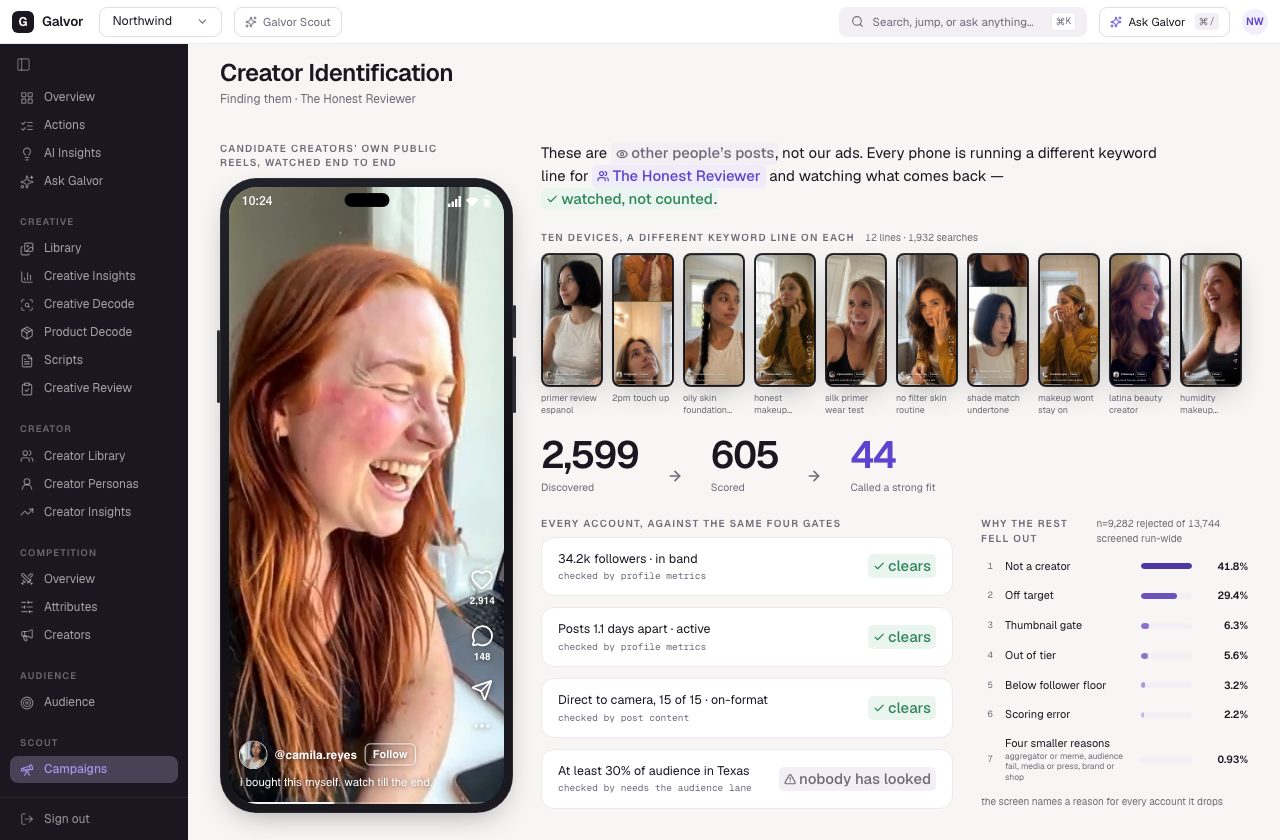
Which creators matched the brand, reached the right audiences and delivered.
How communities responded, what they trusted, and what triggered purchase intent.
Which recommendations were acted on — and what happened afterward.
The model trains on your data, not an industry average — so it works wherever your data lives.
Bold claim × product demo found at 4.84× RoAS — with only 7% of spend allocated there. Reallocated in month one.
"{{ resultQuotes.0.text }}"
{{ resultQuotes.0.cite }}
Tutorial-format nano creators outperformed lifestyle creators 2.8× on RoAS. Hook rate rose from 4.2% to 11.8%.
"{{ resultQuotes.1.text }}"
{{ resultQuotes.1.cite }}
Science-credible long-form testimonials: 2.6× conversion uplift in whitespace no competitor was funding.
"{{ resultQuotes.2.text }}"
{{ resultQuotes.2.cite }}
Every capability below is operational or in active development — technical language is never used as decoration.
In 30 minutes, we'll run your campaign history through Galvor and show you three things:
Your RoAS forecast — what your next campaign is likely to deliver, before you spend.
Your top creative cluster — and how much budget is currently missing it.
Your biggest competitive gap — where category leaders are spending that you're not.
30 minutes. Your data. No deck.